
Your AI Prompt Is Not the Problem
The environmental case against AI is aimed in the wrong direction.
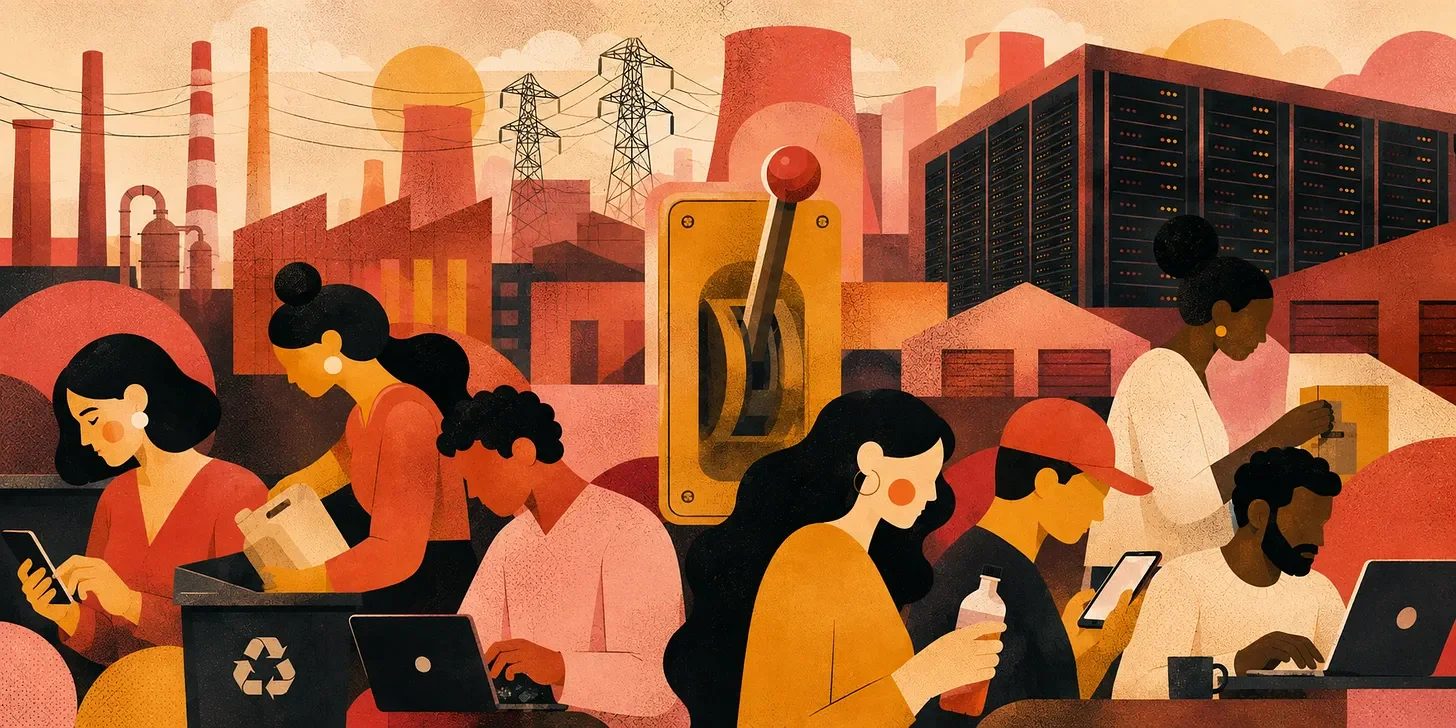
There is a story you have heard about AI and the planet.
A technology arrived, it started burning through electricity and water at planetary scale, and the responsible thing to do is to stop using it.
That story has never sat well with me. Not because the numbers are wrong because they’re not. Data centers consume enormous amounts of electricity and water, and the growth of AI is making those demands much larger.
I’ve questioned it because I’ve always felt like it’s pointing the finger at the wrong thing and it’s giving me a sense of déjà vu.
We saw it with plastic, when an environmental problem created by a manufacturing system was gradually reframed as a problem of individual behavior. We taught people to rinse their containers, sort their recycling, and feel guilty about the things they threw away, while the companies producing billions of disposable containers kept producing them.
I spent years working on that problem. I co-founded LimeLoop, a reusable shipping mailer designed to replace single-use cardboard, and help people repeatedly try to solve a systemic problem with the small piece of cardboard in front of them.
The AI conversation feels strangely familiar.
So I went back and looked at why.
AI is not new. The wrapper is.
Some of what follows depends on knowing that AI did not arrive in November 2022.
The field was founded in the summer of 1956, at a workshop at Dartmouth College convened by John McCarthy. LISP, one of the foundational programming languages of AI research, was written in 1958. ELIZA, the first natural-language chatbot, was built at MIT in 1966. By the mid-1960s, AI labs were operating on multiple continents, funded heavily by the U.S. Department of Defense.
The generative, transformer-based version of AI that the current conversation is really about is newer, roughly 2017 onward, and it is genuinely more compute-hungry than what came before. That distinction matters. The environmental cost is not imaginary, and pretending otherwise would make the argument easier to dismiss.
But AI did not suddenly become environmentally consequential when ordinary people gained access to it.
What changed in 2022 was the wrapper.
For most of AI’s history, using these systems required a considerable amount of technical knowledge. You needed to understand programming, machine learning, models, datasets, and the machinery underneath the thing you were trying to use. A handful of companies stripped most of that away and put a text box in front of it.
You type. It answers.
The wrapper is the innovation the public actually met.
And that distinction matters because the environmental problem we are talking about is not simply a problem with artificial intelligence. It is a problem with the way this particular version of AI has been deployed, priced, and scaled.
Cheap AI is a choice
Global data centers consumed roughly 448 terawatt-hours of electricity in 2025, with AI accounting for about a fifth of the total. If data centers were a country, they would be the world’s eleventh-largest electricity consumer. Water use is on a similar trajectory: data centers in Texas alone are projected to use 49 billion gallons of water in 2025, and as much as 399 billion gallons in 2030.
Those numbers are real.
The question is what is causing them to grow.
Data centers do not expand because AI exists. They expand because demand for AI expands. And demand, as it does with almost everything else, is shaped by price.
OpenAI reportedly lost around $5 billion in 2024 while generating roughly $3.7 billion in revenue. Every time you send a complex query, the AI lab is effectively losing money on the transaction.
The twenty-dollar subscription is therefore not a normal price for a computational resource. It is a subsidy, funded by venture capital and designed to make the technology feel inexpensive enough that people will use it without thinking very hard about what each interaction actually costs.
You can ask the model to rewrite a text to your landlord, generate a birthday poem for a coworker, or summarize a meeting you could have read yourself, and nothing about the transaction tells you that you have just consumed an expensive computational resource. The marginal cost, from the user’s perspective, is effectively zero.
Why wouldn’t you use it?
Enterprise pricing works the same way at a different scale. Uber’s CTO confirmed that the company burned through its entire 2026 AI budget in four months after Claude Code adoption jumped from 32 percent to 84 percent of its 5,000-engineer organization, with monthly costs per engineer ranging from $500 to $2,000.
Cheap things get used a lot. When something that was once expensive becomes nearly free, people discover new uses for it. Some of those uses are valuable. Some are frivolous. The important thing is that the price no longer tells you much about the cost of the thing being consumed.
The data center buildout is a function of demand. Demand is a function, in part, of price.
And once you see the environmental problem through that lens, another part of the AI story comes into focus.
The same subsidy changes the economics of automation
The reason a company can look at a team of ten and decide that four people can be replaced by an AI subscription is, in part, that the subscription is priced below what four salaries cost.
If the AI subscription were priced at its true cost, that calculation would change in a lot of cases. Some automation would still make sense. Much of it would not.
We are already watching companies discover this distinction in real time, as the technology costs more than expected in some applications and does not perform the work as reliably as companies initially assumed.
That reckoning is happening one company at a time, one budget at a time.
But the environmental point and the labor point are not separate arguments. They are two consequences of the same distorted price signal.
The subsidy makes it rational to build more data centers because demand looks enormous. It makes it rational to automate more work because the AI looks cheaper than the humans doing it.
If the price were more honest, some of that demand would disappear.
The technology would still be powerful. It would still change how people work. It would simply be operating inside a market that was giving buyers a more accurate signal about what they were consuming.
Instead, we are asking a different question. Whether the user should feel bad for using it.
That question should sound familiar.
We have seen this before
In 1953, after Vermont banned disposable bottles, beverage and packaging companies including Coca-Cola formed Keep America Beautiful to combat litter without blaming corporations.
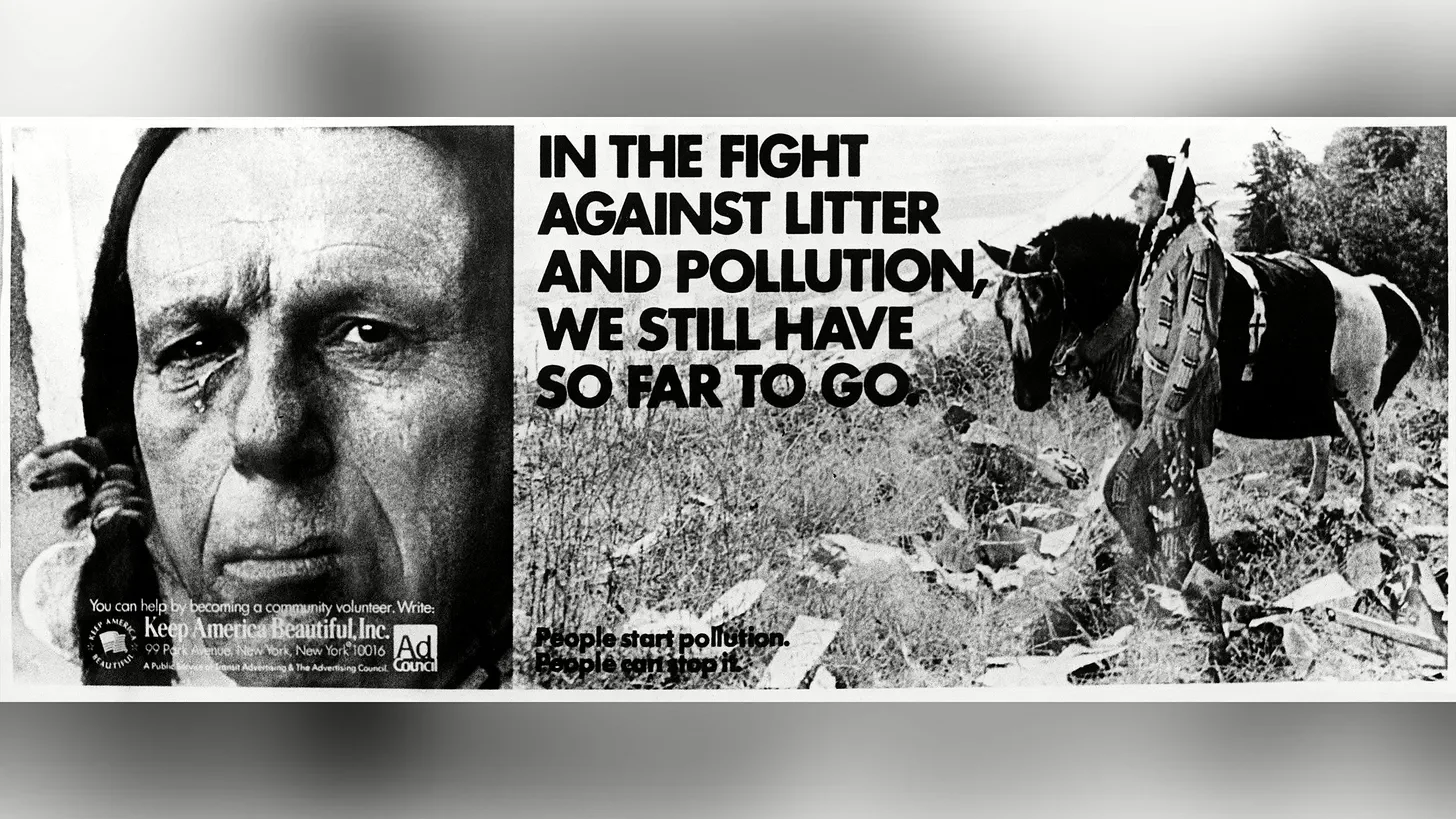
The basic framing was that litter was a problem of individual behavior.
In 1971, Keep America Beautiful aired its iconic “Crying Indian” commercial with the tagline, “People start pollution. People can stop it.”
Behind the scenes, the beverage industry spent an estimated $20 million annually in the mid-1970s fighting “bottle bills” that would have made companies responsible for taking back their own containers.
The public got a marketing campaign that made individual behavior the center of the conversation, while the companies behind it bought themselves another few decades before being forced to take responsibility for the waste their products created.
The result was a remarkably durable idea: the consumer was responsible for what happened to the product after the sale.
You rinse your yogurt container. Your neighbor does not. You argue about it. Nestlé keeps making yogurt containers. The genius of the framing was not that it convinced people that pollution did not exist. It convinced people that they were looking at the right part of the problem.
The container was right there in front of them. It was tangible. They could make a decision about it.
What they could not see from that position was the system that had produced the container in the first place, or the decisions that made producing another container cheaper and easier than designing a system in which the container did not need to exist.
Call it the Litterbug Playbook

This is the pattern I keep seeing.
Call it the Litterbug Playbook.
A corporation profits from a product that creates a negative externality. Instead of absorbing the cost of that externality, the problem is reframed as one of individual behavior. The public then spends years arguing about personal responsibility while the production system remains largely untouched.
The play works because it gives people something they can control.
It is not hard to understand why that is appealing. If the problem is your recycling, you can recycle better. If the problem is your driving, you can drive less. If the problem is your AI usage, you can write fewer prompts.
There is something psychologically satisfying about being given a lever you can actually pull.
The problem is that the lever may not be connected to much.
That is what I learned building LimeLoop.
The consumer had been handed the wrong lever

I spent years building LimeLoop with my co-founder, a reusable shipping mailer designed to replace single-use cardboard. A single LimeLoop mailer replaces more than 50 boxes over its lifetime and cuts the carbon footprint of a shipment by up to 85 percent.
The math is not especially complicated.
The more interesting thing was watching how people thought about the problem.
Customers would ask, earnestly, whether they were recycling their Amazon boxes correctly. They wanted to be good. They wanted to do the right thing with the piece of cardboard in their hands.
And they had been handed a problem that looked manageable.
There was a box. There was a recycling bin. There was a correct behavior.
What they could not see from that position was the system that had produced the box in the first place, or the decisions that made producing another box cheaper and easier than designing a system in which the box did not need to exist.
The piece of cardboard in their hand was never the point. The point was that a system had been designed to produce that piece of cardboard by the billion, and to make its disposal the consumer’s responsibility.
That was the lesson I kept coming back to: the consumer had been handed the wrong lever.
The AI equivalent of that piece of cardboard is your prompt.
We are being asked to look at the thing we can personally control and treat that as the site of the environmental problem. But the prompt is not the point.
You can see what the right lever looks like

One of the easiest ways to see this is to look at what happens when the lever moves upstream.
On July 3, 2024, the European Union began requiring that plastic caps on single-use beverage bottles stay attached to the bottle. Consumers did not have to be convinced.
They did not have to learn a new moral vocabulary. Nobody had to stand in the grocery store and explain that responsible people keep their bottle caps attached. The bottle changed. Every bottler operating in Europe had to respond, and consumers encountered a different product on the shelf. That is what regulation looks like when it reaches the production system rather than asking every individual consumer to compensate for the system’s decisions.
The interesting thing is how little consumer behavior had to be changed to make this happen. Change the product upstream and millions of individual decisions change with it.

The same principle applies to cars. If every car available for purchase is a gasoline-powered car, the carbon that results is not evidence that millions of individuals have independently decided that they prefer to pollute. It is also evidence that the choices available to those people were shaped upstream.
Change what manufacturers are allowed to sell and consumers encounter a different set of choices.
The disclosure
I run BAMPT, an AI consultancy. My team and I build AI systems into marketing workflows, operations, and lead generation for other businesses. I use these tools every day. My opinions about them are shaped by using them, and by billing clients for outcomes that depend on them.
I recognize that this makes me not a neutral observer. I mention this because the usual move, when someone defends AI, is to assume that they have not thought seriously about its costs.
I have.
I think about them for a living. That is exactly why the framing bothers me.
The Litterbug Playbook works particularly well on people who are trying to be responsible. It gives them something they can control. It gives them a way to participate. It lets them feel that they are doing their part. That is psychologically powerful and convenient.
If the problem is your prompt, the solution is for you to use fewer prompts.
If the problem is the data center, the solution gets much more complicated.
AI is a utility. The companies deploying it are not.
There is a temptation to argue that AI is inherently good or inherently bad.
I think that is the wrong level of abstraction.
I see AI as a utility. So is the internet. So is electricity. Any of them, left unregulated, can become a lever for whoever controls the infrastructure to extract value while pushing costs outward.
The internet enabled the largest companies of our day. It also enabled entire categories of exploitation, wealth concentration, labor disruption, and environmental damage.
We do not usually say that we are against the internet because Amazon has a fulfillment-center problem. We argue about what Amazon is allowed to do, what obligations it has to workers and communities, and what rules should govern the consequences of concentrating so much economic power in one place.
AI belongs in the same conversation. The model is not the company deploying it. The prompt is not the data center producing it. And the person writing the prompt is not the person deciding where the data center gets built.
Capitalism is not designed to limit its own negative externalities. It is designed to maximize revenue. That is not a moral failing of capitalism. It is the reason regulation exists.
The job of regulation is to make the costs that a market would otherwise push outward part of the economic calculation.
That is the lever we should be arguing about.
What would it look like to move the lever?
Once you stop asking whether an individual person should feel bad for asking Claude to draft an email, the policy questions become much more interesting.
What emissions reporting should data centers be required to disclose?
What water-use caps should apply in drought-vulnerable regions?
Where should hyperscale data centers be allowed to locate?
Should facilities be required to demonstrate access to renewable energy rather than relying on corporate-level offset accounting?
Who should pay for the transmission infrastructure required by enormous new electricity loads?
What happens when those costs are passed through to residential ratepayers?
In states with a high concentration of data centers, electricity prices have increased by up to 267 percent over the last five years. Low-income households can spend up to 20 percent of their income on energy, compared with 3 percent for higher-income households. At that point, the question is no longer whether your prompt was necessary. It is who is subsidizing the infrastructure required to make the prompt possible.
The point is not that consumers have no responsibility
There is an easy version of this argument that I do not believe.
It would say that consumers have no responsibility at all, that every individual choice is irrelevant, and that the only thing that matters is regulation.
I don’t believe that is true.
Consumers are part of the system. Our choices matter. If you are generating a hundred images you do not need, it is reasonable to ask whether that is a useful way to spend a resource. But individual responsibility and systemic responsibility are not interchangeable.
A person can recycle perfectly and still live in a system that produces billions of disposable containers. A person can drive less and still live in a transportation system designed around cars.
A person can use AI thoughtfully and still live in an economy in which the companies selling AI are incentivized to maximize usage while externalizing the cost of the infrastructure required to support it.
The question is not whether we should care about our own behavior. The question is whether we should mistake our own behavior for the place where the largest lever exists.
That is what the Litterbug Playbook teaches us to do.
The moral is not the litter
We are looking at the prompt because the prompt is the part of the system we can see. We can count it. We can imagine changing it. We can decide to use one fewer query, generate one fewer image, or write one more email ourselves.
But the prompt is sitting at the end of a much larger chain of decisions about capital, infrastructure, pricing, energy, water, regulation, and corporate strategy.
We have spent sixty years looking for the litter. The bottle was never the problem. The bottler was. And now we are being asked to look at the prompt.
Maybe we should use these tools thoughtfully. Maybe some uses are wasteful. Maybe the true cost of computation should change how often we reach for it.
But if the story we tell ourselves is that the environmental cost of AI is fundamentally a consequence of millions of individual people asking chatbots unnecessary questions, we have already made the same mistake.
We have taken the visible end of the system and mistaken it for the system itself. We have seen it before in the Litterbug Playbook.
Will we do something different this time?